Veteran Owned & Operated

Small business SEO services make your website easier for search engines to understand and easier for customers to find. The work that pays off most sits in your site itself: its content, structure, speed and mobile experience. That is why the best-placed provider is one who can build and fix the site as well as optimize it. At Hire Jordan Smith, that is how we work: one designer-developer, talking to you directly, handling the SEO and the website it depends on.
This guide covers what SEO services include, what they cost in the US, how long they take, and how to judge a provider before you sign. It is written for small business owners, law firms, non-profits and agencies that need a dependable developer.
TL;DR
- SEO services cover keyword research, content, technical fixes, local search setup and measurement. Google’s own guidance says a good SEO can improve your site’s visibility.
- US pricing varies widely: from low hundreds of dollars a month to $10,000 or more, and one-time audits from about $500 to $30,000.
- Expect early technical gains within weeks and measurable results in about three to six months, longer in competitive fields.
- Rankings can’t be guaranteed by anyone. A provider who promises a first-place ranking is a warning sign.
- A provider who also controls your site’s design and code can make SEO changes without handoffs, which saves time.
Table of Contents
- What SEO services actually do for a small business
- What is included in small business SEO
- Why the website itself decides how far SEO can go
- What SEO costs in the US
- How long SEO takes to show results
- How to choose an SEO provider
- Special cases: law firms, non-profits, agencies and online stores
- Where we fit
- Small business SEO checklist to bring to any conversation
- FAQ
- Sources
What SEO services actually do for a small business
Google describes SEO as helping search engines understand your content and helping users find your site and decide whether to visit it. Google Search Central’s Starter Guide is direct about the limits: following good practice improves your eligibility to appear, but it does not guarantee indexing or a first-place ranking.
Within that frame, Google lists what an SEO professional can do: review your site’s content or structure, advise on technical development, create content, manage online campaigns, research keywords, provide training, offer market and geographic expertise, and optimize for generative AI search. The same page says hiring an SEO can potentially improve your site’s visibility.
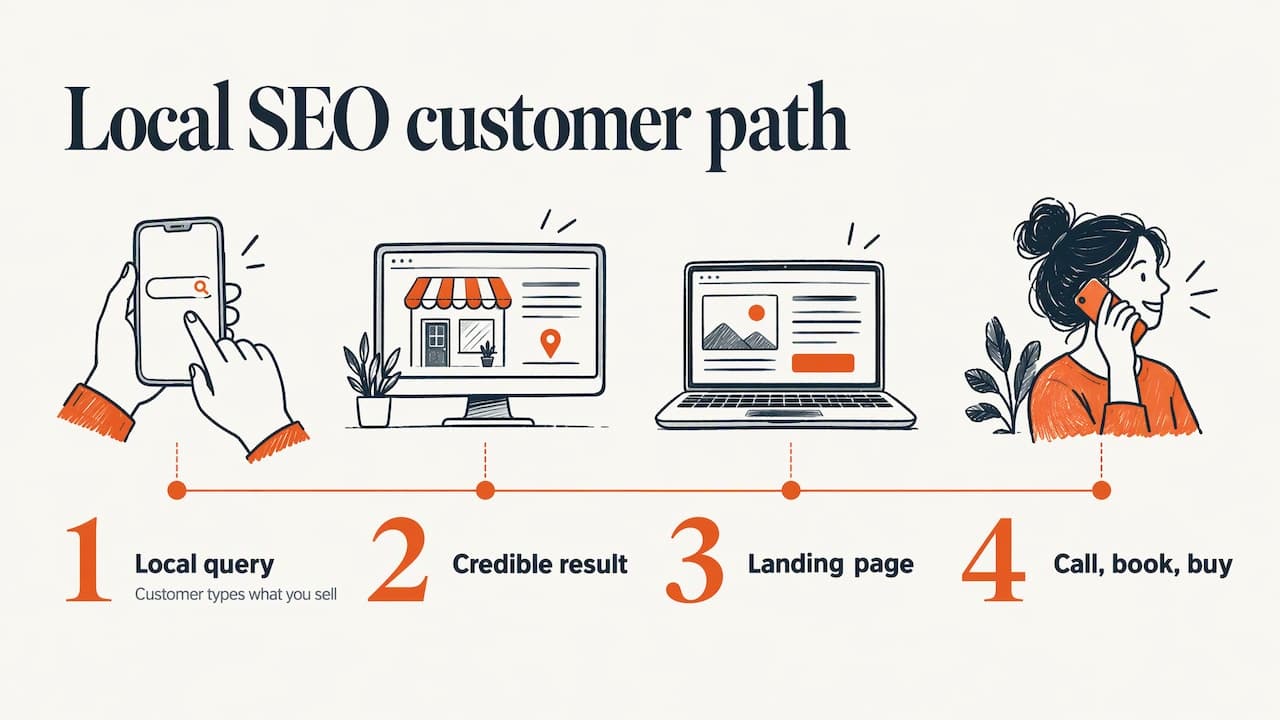
For a small business, that translates into a simple goal: when someone nearby types what you sell, your site is a credible result, and the page they land on makes them call, book or buy.
What is included in small business SEO
Packages differ in wording, but the work falls into five groups.
Keyword research and search intent
This means finding the phrases your customers actually type and matching each to a page that answers it. A law firm needs a page for each practice area and city it serves. An e-commerce store needs category and product pages. A non-profit needs pages for its programs, donations and volunteer sign-ups.
Content that helps people
Google’s Starter Guide says compelling, unique, current, helpful, reliable, people-first content is likely to influence your search presence more than most other improvements. The same guide notes there is no magic word count, that Google does not use the keywords meta tag, and that keyword stuffing violates its spam policies. Good SEO copy reads like a clear answer from someone who knows the subject.
Technical foundations
This covers page speed, mobile layout, secure connections, clean code, crawlable navigation and structured data, which is extra markup that tells search engines what a page is about. Most of these live in the website’s build, not in a plugin you can switch on. Our articles on web design and SEO working together and secure web development practices explain how.
Local search setup
If customers come from your area, your Google Business Profile (the free listing that appears in Maps and local results) needs accurate details, photos and reviews. Your site should show the same name, address and phone number, with a page for each location or service area. Our guide on using web design for local SEO goes further.
Measurement and reporting
Traffic alone is not the goal. A useful report ties search visits to calls, form submissions and sales, and says what was changed that month.
Why the website itself decides how far SEO can go
Most SEO advice assumes you can change your site freely. In practice, many small businesses hit a wall: the template can’t be edited the way the strategy needs, pages load slowly, the mobile layout is cramped, or the contact form is buried. An SEO who only writes recommendations then hands them to a developer, who hands questions back.
That loop is where weeks disappear. When the person optimizing your site is also the person who builds it, a recommendation becomes a change the same day. This is the reasoning behind why SEO website design matters to your business: the design is the SEO.
A short example. Say a family law practice wants to rank for divorce attorney searches in its city. The work needs a dedicated page per service, a fast mobile layout, a clear consultation form, attorney profile pages and a consistent local listing. Strategy, copy, layout and code are all connected. Splitting them among three vendors multiplies the meetings, not the results.

What SEO costs in the US
No single price applies, and published figures should be read as ranges, not quotes.
Forbes Advisor reports that ongoing SEO can run from the low hundreds of dollars to $10,000 or more per month, depending on needs. The same source says simple backlink-check audits can start around $500, while full content audits can reach $30,000, usually as one-time fees. Search Engine Land reports typical SEO consultant hourly rates of $50 to $150, and warns that unusually low pricing can signal weak quality or unethical practices.
What moves the price:
- Site size. More pages mean more to audit, write and maintain.
- Competition. Ranking for a term many businesses want takes more work than a niche local phrase.
- Geography. One city is simpler than a multi-state service area.
- Site condition. A slow, outdated or hard-to-edit site needs repair before content can help.
- Scope. Content creation, link building and reporting each add effort.
We do not publish fixed prices for our services, because the scope depends on your site and goals. Each project is quoted after we talk through what you need.
How long SEO takes to show results
Google says changes can take anywhere from a few hours to several months to appear in Search, and recommends waiting a few weeks to judge whether your work had a beneficial effect. Not every change produces a noticeable impact.
Search Engine Land’s timeline guide puts typical measurable results at three to six months, and six to twelve months for significant ranking and revenue impact in competitive industries. It adds that early technical or on-page gains can show within weeks, while sustained traffic growth builds cumulatively and depends on site age, authority, how quickly changes are made, and recrawling.
Implementation speed is the one factor you can influence directly through your choice of provider. If every fix waits in a queue for a separate developer, the clock runs slower.
A realistic first year
- Month one: audit, keyword plan, technical fixes, local listing cleanup.
- Months two and three: key service pages rewritten or built, speed and mobile issues resolved, tracking confirmed.
- Months three to six: first measurable movement in impressions, clicks and inquiries.
- Months six to twelve: new content and earned links compound, especially in competitive markets.
Treat this as a pattern, not a promise. Your starting point decides the pace.
How to choose an SEO provider
Google’s guidance on hiring gives a solid checklist. Interview candidates about their prior work, how they follow Google’s guidelines, the results and timeframe they expect, how they measure, their industry and local experience, how they communicate, how they document changes, and what references they can give.
Use these questions:
- What will you do in the first 90 days? You should get specifics, not a generic list.
- Who does the work? Find out whether the person you speak with is the person who touches your site.
- What do you need to know about my business? Google says a prospective SEO should ask about your business, competitors, customers and what makes you unique. Lack of interest is a warning sign.
- How will you report? Ask how often and by what means you will get updates.
- Can I see results tied to leads or revenue? Search Engine Land advises reviewing case studies with specific outcomes, and checking testimonials or references.
- Who owns the site, content and accounts? You should keep access to everything.
Red flags: guaranteed rankings, secrecy about tactics, and prices far below the market.
Special cases: law firms, non-profits, agencies and online stores
Law firms compete on trust and local relevance. Practice-area pages, attorney bios, clear contact paths and a site that loads fast on a phone do more than generic blog posts. Our piece on communicating credibility on your homepage applies directly.
Non-profits usually need to be found for a mission and a location, and need donation and volunteer pages that work smoothly. A site that staff can update themselves matters, since budgets rarely allow constant outside edits. We include WordPress training for exactly that reason.
Agencies that need a reliable developer for client projects benefit from one point of contact who can implement technical SEO requirements without a project manager in between.
E-commerce stores need product and category pages built for search intent, fast loading and clean mobile checkout.
Where we fit
We are Jordan Smith’s web design and development practice. Jordan has more than 15 years of experience and has built more than 700 custom websites for law firms, non-profits, e-commerce stores and service businesses. You communicate with him directly at every stage, with no intermediaries, which the owner’s approach ties to faster, more accurate delivery.
Our search engine optimization service sits alongside the work that makes SEO effective: mobile-responsive builds, page speed optimization, hosting and maintenance, website consulting and ongoing support.

If your site needs to be built, redesigned or optimized so it can actually compete in search, start with our web design and development services and tell us what you want the site to achieve.
Small business SEO checklist to bring to any conversation
Whoever you hire, make sure these are covered:
- Every service or product has its own page with a clear purpose.
- Page titles and descriptions are unique and written for people.
- The site loads quickly and displays well on phones.
- The site uses HTTPS, and navigation is logical, with internal links between related pages.
- Your Google Business Profile is complete and matches your site.
- Contact forms work and calls or submissions are tracked.
- A monthly report explains what changed and what it produced.
For more depth on the building blocks, read our ultimate SEO guide and the five must-have website features for small business.
FAQ
How much should a small business spend on SEO?
Ongoing SEO is reported to range from the low hundreds to $10,000 or more a month, so your budget should follow your market’s competition and your site’s condition. Ask for a scope tied to specific pages and outcomes. One-time audits can cost from about $500 upward, per Forbes Advisor.
Can anyone guarantee a first-page ranking?
No. Google states there is no secret that automatically ranks a site first and no guarantee a particular site will be indexed. Treat a promised ranking as a reason to look elsewhere. Reliable providers describe the work, the timeline and how they will measure progress.
How long before I see results?
Early technical gains can appear within weeks. Measurable results typically take three to six months, and competitive industries may need six to twelve months, according to Search Engine Land. Your site’s age, authority and how fast changes are implemented all matter.
Do I need a new website to do SEO well?
Not always, but the site must be fast, mobile-friendly, secure and editable enough to carry the changes. If your current site blocks those, a rebuild or redesign often makes SEO work faster and more effective. Our post on signs it is time to redesign can help you decide.
Sources
- Do You Need an SEO? Tips for Hiring an SEO, Google Search Central
- SEO Starter Guide: The Basics, Google Search Central
- How Much Does SEO Really Cost? Forbes Advisor
- SEO consultants guide: When to hire and what to expect, Search Engine Land
- How long does SEO take to work? Search Engine Land
Recommended
- Why SEO Website Design Is Important to Your Business
- 5 Local SEO Tips That You Can DIY (No Expert Required)
- How to Use Web Design for Local SEO Optimization
- Web Design and SEO 101: How You Can Delight Your Customers